B2B sales, short for business-to-business sales, is when one company sells a product or service to another company rather than to an individual consumer. A CRM subscription sold to a sales team, components sold to a manufacturer, and consulting sold to a growing business are all B2B sales.
In practice, B2B sales means finding the right accounts, understanding a business problem, building agreement among the people involved, and showing why the purchase is worth making. Deals often need more research and follow-up than consumer purchases because the buyer is making a decision for the business, not just for themselves.
What makes B2B sales different?
- Several people can influence the decision. A user, manager, finance stakeholder, and executive sponsor may all have different concerns.
- The purchase needs a business case. Buyers want to understand the expected value, implementation effort, risk, and fit with their current process.
- Sales cycles can involve discovery calls, demonstrations, internal reviews, negotiation, and procurement.
- Relationship and context matter. A useful conversation starts with what the buyer is trying to improve, not a generic pitch.
- CRM hygiene affects follow-up. When account details, conversations, and next steps sit in separate tools, opportunities are easier to miss.
B2B sales examples
B2B selling appears across software, manufacturing, professional services, and logistics. Common examples include:
- A software company selling a CRM subscription to a five-person sales team.
- A manufacturer supplying components to an equipment company.
- A marketing agency selling demand-generation services to a SaaS business.
- A cybersecurity provider selling a platform to an IT department.
- A logistics company winning a contract to manage shipping for an online retailer.
Each example follows the same pattern: a company is buying for a commercial or operational purpose, and the seller must connect the offer to an outcome the buyer can defend internally.
B2B sales vs. B2C sales
| Area | B2B sales | B2C sales |
|---|---|---|
| Buyer | A company or buying group | An individual consumer |
| Decision process | Often includes research, approval, and several stakeholders | Often made by one person |
| Sales cycle | Usually longer and more consultative | Often shorter and more transactional |
| Primary proof | Business value, fit, risk, and return on investment | Personal need, preference, convenience, or price |
| Follow-up | Account history, stakeholder context, and next actions matter | Marketing, service, and repeat purchases often drive retention |
The boundary is not absolute. A small-business buyer may make a fast decision, while a consumer may spend weeks comparing a major purchase. Still, B2B teams should plan for more people, more context, and more scrutiny.
How the B2B sales process works

1. Define the accounts and people worth pursuing
Start with an ideal customer profile. Consider company size, industry, business model, geography, current tools, and the problem your product solves. Then identify the people who use the product, influence the decision, or own the budget.
For LinkedIn-led prospecting, a focused search is more useful than a long list of loosely matched contacts. Build a prospecting list that supports a real sales motion before outreach begins.
2. Research before outreach
Look for a reason to start a relevant conversation. A hiring change, new market, announced initiative, operational gap, or role-specific problem can help a representative ask a sharper opening question instead of treating every account the same.
3. Start a useful conversation
The first message does not need to explain every product feature. It should give the prospect a clear reason to respond. Lead with the problem you can help solve, show why the message fits their role or company, and make the next step easy.
4. Qualify the opportunity through discovery
Discovery turns a lead into a qualified opportunity. Ask how the team works now, what slows it down, who feels the impact, what a better outcome looks like, and what needs to be true for a change to get approved. Capture those answers in the CRM while they are fresh.
A framework such as BANT or MEDDIC can help a team ask consistent questions, but forcing every conversation into a script misses the goal. What matters is learning whether there is a real problem, a workable path to change, and the right people involved in that decision.
5. Demonstrate the right workflow
A strong demo shows how the buyer’s team would move from its current process to a better one. A team that prospects on LinkedIn, for example, may need to see how prospect details, company context, and conversation history reach its CRM without repetitive manual entry.
6. Build consensus and close
Give each stakeholder the information they need to decide. A sales manager may care about pipeline visibility, a representative may care about time saved, and a finance stakeholder may care about the commercial case. Confirm owners, next steps, timing, and evaluation criteria rather than ending a call with a vague promise to follow up.
7. Keep the handoff clean
The sale does not end when the agreement is signed. A useful handoff gives the customer-facing team the goals, stakeholders, use case, and commitments that shaped the deal. It also gives the sales team a better starting point for renewal and expansion conversations.
B2B sales strategies that improve follow-through
Build around a specific problem
Generic outreach gets ignored because it asks the buyer to make the message relevant. Name the operational problem you solve and explain why it matters to that role.
Work accounts, not isolated leads
One contact rarely tells the whole story. Map the people who use, influence, approve, or block a purchase. You do not need to contact everyone at once, but you do need to understand where each conversation fits.

Make personalization useful
Personalization should change the substance of the message. Referencing a company name is not enough. A useful message reflects the buyer’s likely workflow, priority, or obstacle and earns the right to continue the conversation.
Protect sales context in the CRM
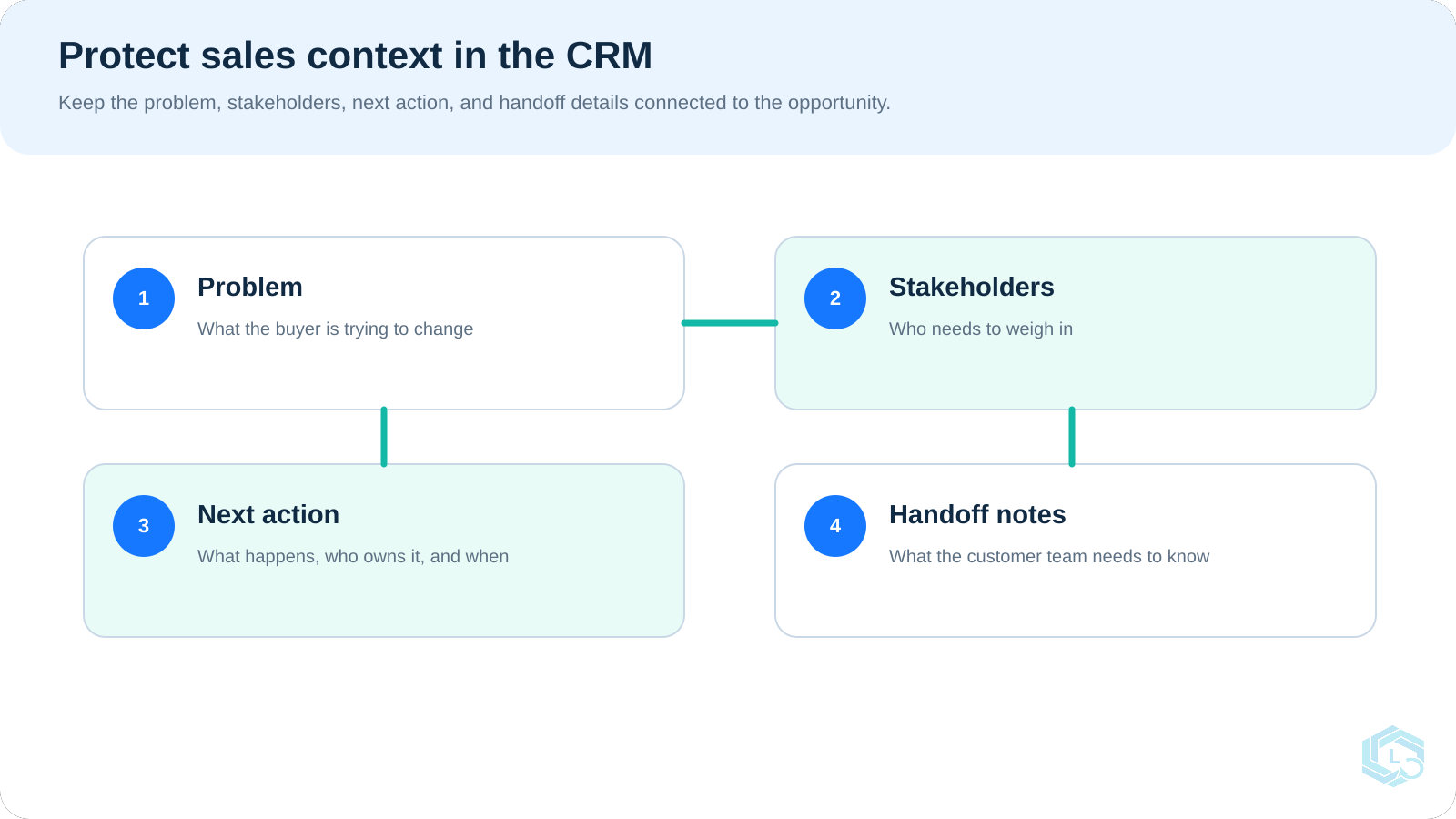
Representatives lose momentum when they need to reconstruct a prospect’s background before every follow-up. Keep contact information, account notes, messages, ownership, and next steps in the CRM. If LinkedIn is a core prospecting channel, a LinkedIn-to-CRM workflow can help keep that context connected to the record.
Review pipeline quality, not only volume
A growing pipeline helps only when opportunities are qualified and moving forward. Review stage conversion, stalled deals, missing next steps, and the accounts that repeatedly match your best customers. Use those patterns to sharpen targeting and discovery.
How to manage B2B sales with a CRM
LinkedIn is where many B2B representatives find and research prospects. The CRM is where the team records the account, coordinates follow-up, and manages the opportunity. Copying information between the two can leave incomplete records, lost messages, duplicate contacts, and unclear ownership.
LeadCRM’s LinkedIn-to-CRM data sync helps teams bring user-accessible LinkedIn profile information into the CRM they already use, apply field mappings, and keep prospecting context available for follow-up. The extension can also help a representative check whether a prospect already exists before creating a new record.
For teams that need more complete records before a conversation, waterfall data enrichment can support a controlled enrichment process. Choose the fields that matter, decide how existing values should be handled, and give representatives enough context for a better next move.
LeadCRM fits best alongside a disciplined process: focused targeting, relevant outreach, documented discovery, clear next steps, and a CRM that reflects what is happening with the account.
Try LeadCRM’s LinkedIn-to-CRM workflow free if your team wants to keep prospect research and follow-up connected to the CRM.
Frequently asked questions about B2B sales
What are B2B sales?
B2B sales are transactions where one business sells a product or service to another business rather than a consumer. The term includes software subscriptions, raw materials, professional services, and enterprise contracts, and the buyer is almost always deciding on behalf of the company rather than for personal use.
What is B2B sales in simple words?
B2B sales is when a business sells to another business. The deal usually involves a business need, more than one stakeholder, and a process that includes research, conversations, and follow-up.
What are examples of B2B sales?
Examples include a software company selling a CRM to a sales team, an agency selling marketing services to a brand, and a supplier selling materials to a manufacturer. The buyer is purchasing on behalf of a business.
Why can B2B sales take longer than B2C sales?
A B2B buyer may need to involve colleagues, compare options, justify the purchase, and fit it into an existing workflow. That approval process can add more steps than a typical consumer purchase, though the actual length of any sale still depends on the product, the price, and how many people need to sign off.
What skills do B2B sales representatives need?
Strong representatives research accounts, listen during discovery, communicate business value clearly, manage several stakeholders, and follow through. Accurate CRM records also help the wider team act on the same information.
Turn prospecting activity into a repeatable B2B sales process
A good B2B sales process makes the next step clear for the buyer and seller. Start with the right accounts, learn what the buyer needs to change, and keep a record of each conversation the team can use later.
If your team prospects on LinkedIn and needs that work to flow into its CRM, explore the LeadCRM LinkedIn Chrome extension for B2B prospecting. It can help connect prospect research, CRM records, and follow-up. Create a free account to try the workflow.